
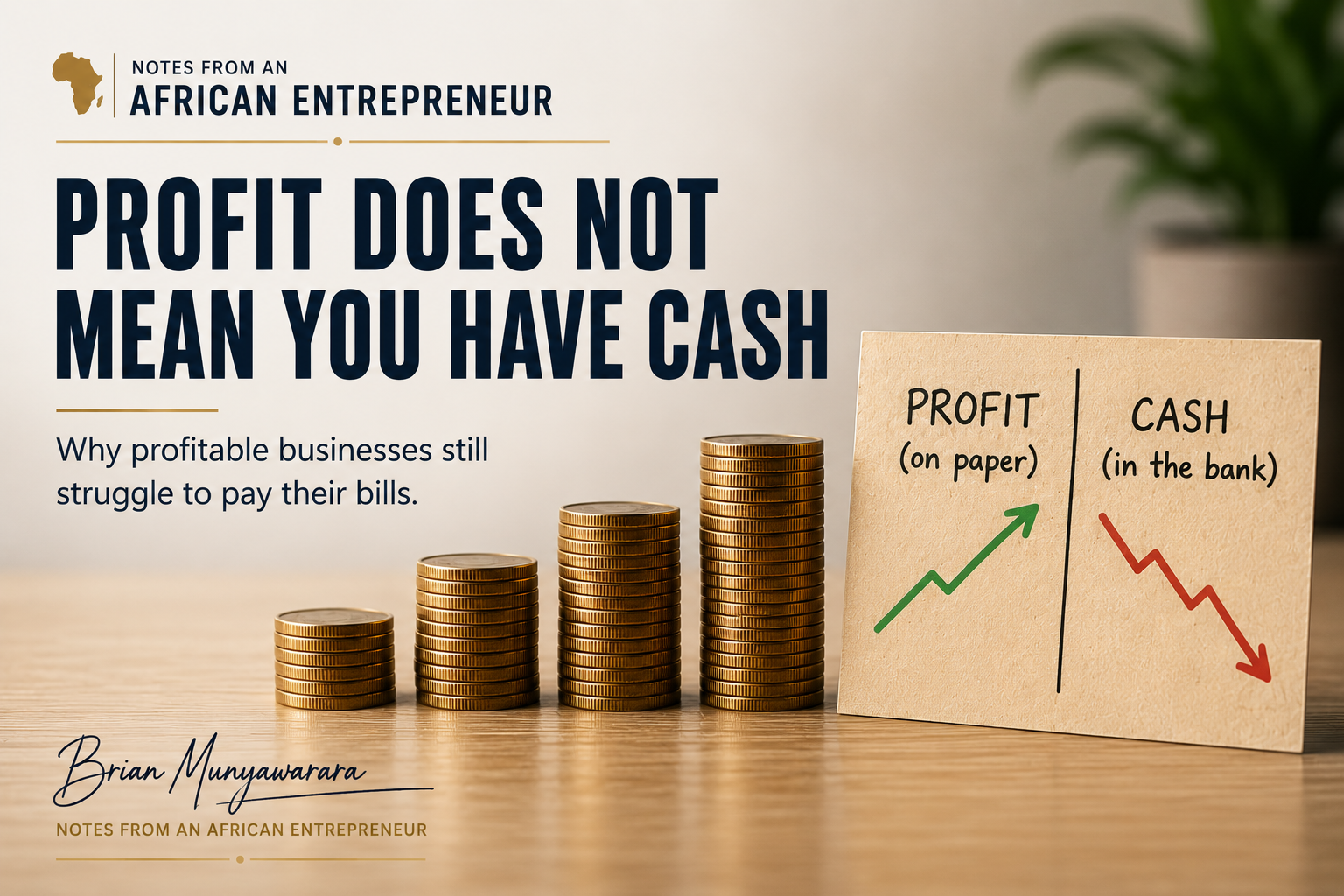
Profit Does Not Mean You Have Cash
Many people in business mistakenly think that if a company is profitable, it must also have money in the bank. It sounds logical. If a business is making a profit, it seems obvious that it should be able to pay its suppliers, employees, taxes and lenders on time. But profit and cash are not the same thing. A company might show strong profits but still have trouble paying its bills on time. Even with rising sales, valuable assets and a strong order book, it can still face real cash-flow problems.
This is not just an accounting problem. It is also a leadership challenge !
Profit Is Not the Same as Liquidity
Profit is an accounting term. It shows what is left after subtracting expenses from revenue during a certain period. But some of that revenue may not yet have been received. A business might send an invoice today and count it as revenue, even if the customer will only pay in 30, 60 or 90 days. On paper, the business has made a profit. In reality, the customer might still have the cash. At the same time, salaries, fuel, rent, loan repayments, taxes and supplier obligations may already be due.
This is when the pressure starts. Liquidity means that a business can pay its obligations when they fall due. It answers a more urgent question: Does the business have enough cash today to pay what it owes?
A company might own trucks, buildings, equipment, inventory or have significant amounts owed to it. But these assets cannot always be turned into cash quickly enough to pay urgent bills. Even a profitable business can therefore run into trouble if its cash is tied up elsewhere.
Growth Can Consume Cash
Many business owners think that growing their business will fix cash-flow problems. Sometimes growth actually makes them worse. When a business gets more customers, takes on bigger contracts or expands its operations, it often needs to spend money before getting paid. A transport company may need to pay for fuel, drivers, tolls and maintenance before the customer settles the invoice.
A retailer may need to buy more stock before the sales revenue comes in. A growing company may need to hire employees, rent larger premises or invest in equipment before the additional income is collected. This means a business can make more profit while still having less cash available.
Growth uses cash before it produces cash.
That is why leaders need to ask more than one question when assessing new opportunities.
It is not enough to ask: Is this contract profitable?
They must also ask: Can we finance the work until the customer pays?
A contract with a good profit margin can still hurt the business if the customer pays after 90 days while suppliers expect their money within seven days. The deal might be profitable, but the timing of payments may be unsustainable.
Revenue Is Not Cash Until It Is Collected
Entrepreneurs naturally celebrate new contracts and increasing sales. But revenue only strengthens the business once it is actually collected. An invoice is not cash. A promise to pay is not cash. A well-known customer is not necessarily a good customer if they consistently pay late. This is why the quality of revenue matters. A smaller customer who pays within seven days might be more valuable than a bigger customer who pays after 90 days and frequently disputes invoices.
Leaders should therefore pay close attention to: Customer payment behaviour, Credit terms, Invoice accuracy, Debtor ageing, Collection processes, The cost of financing delayed payments. Credit control should not be seen as paperwork for the finance team. It is a key part of business strategy. The ability to collect money consistently is just as important as the ability to generate sales.
Cash-Flow Problems Begin Quietly
Cash-flow problems rarely start with one major event. They usually build through a series of small warning signs. A supplier is paid a few days late. A statutory obligation is postponed. Management starts relying on expected customer payments to settle obligations that are already due. New borrowing is used to repay old borrowing. The business starts paying whichever creditor is applying the most pressure instead of following a planned payment schedule.
Individually, each decision may seem manageable.
Together, these signs may show that the business is losing control of its cash cycle. The risk is that leaders often see the problem but delay dealing with it. They hope a major payment will arrive. They expect a new contract to solve the problem. They assume next month will be better. But hoping for the best is not a cash-flow strategy. The sooner leaders act, the more choices they have. The longer the problem is ignored, the more likely the business will require costly borrowing, damage supplier relationships and make rushed decisions.
Cash Flow Is a Leadership Responsibility
Managing cash flow is not just the finance team’s job. It is a key part of leadership. Business leaders should know how cash comes into, moves through and leaves the company. They do not need to be accountants, but they should understand enough about finance to ask the right questions.
Every leader should know:
How much cash do we have today? What payments are due over the next seven, 30 and 90 days? Which customer payments are expected, and how certain are they? How long does it take us to collect money after completing work? Which contracts are profitable but consume too much working capital?
Are we borrowing to fund growth, daily operations or previous losses?
Without clear answers, leaders are guessing instead of making decisions based on facts. Maintaining a rolling cash-flow forecast is one of the most useful disciplines for any business. It helps managers identify cash problems before they become a crisis. It also helps leaders make better decisions about hiring, expansion, equipment purchases, supplier commitments and debt.
Practical Ways to Protect Liquidity
There are a few simple habits that can make a business much stronger. First, maintain a rolling cash-flow forecast. This should show the money you expect to come in and go out over the coming weeks and months. Second, keep a close eye on receivables. Managers should know who owes the business money, how much they owe and how long the amounts have been outstanding. Third, be careful when agreeing to payment terms. Where possible, customer payment schedules should be aligned with supplier obligations.
Fourth, build a cash buffer. Businesses operating in uncertain environments should not assume that every expected payment will arrive on time. Fifth, consider how every major decision will affect cash. Growth, new contracts, equipment purchases and recruitment should all be tested against the company’s liquidity position. Finally, communicate early when cash-flow problems begin to emerge. Honest engagement with suppliers, lenders and other stakeholders usually works better than silence or promises that cannot be kept.
Trust can survive financial difficulty. But trust rarely survives poor communication.
The Leadership Lesson
Profitability matters. A business cannot survive indefinitely without generating adequate returns. But profit without enough cash is fragile. Having cash without making a profit is also not sustainable. A healthy business needs both profit and liquidity. Profit shows whether the business model is creating value. Liquidity shows whether the business can keep operating. Good leaders need to understand the difference.
It takes discipline to look beyond revenue growth and reported profit and ask a more practical question: Can the business meet its obligations when they fall due?
A company does not only fail when it stops making a profit. It can also fail when it runs out of cash.