
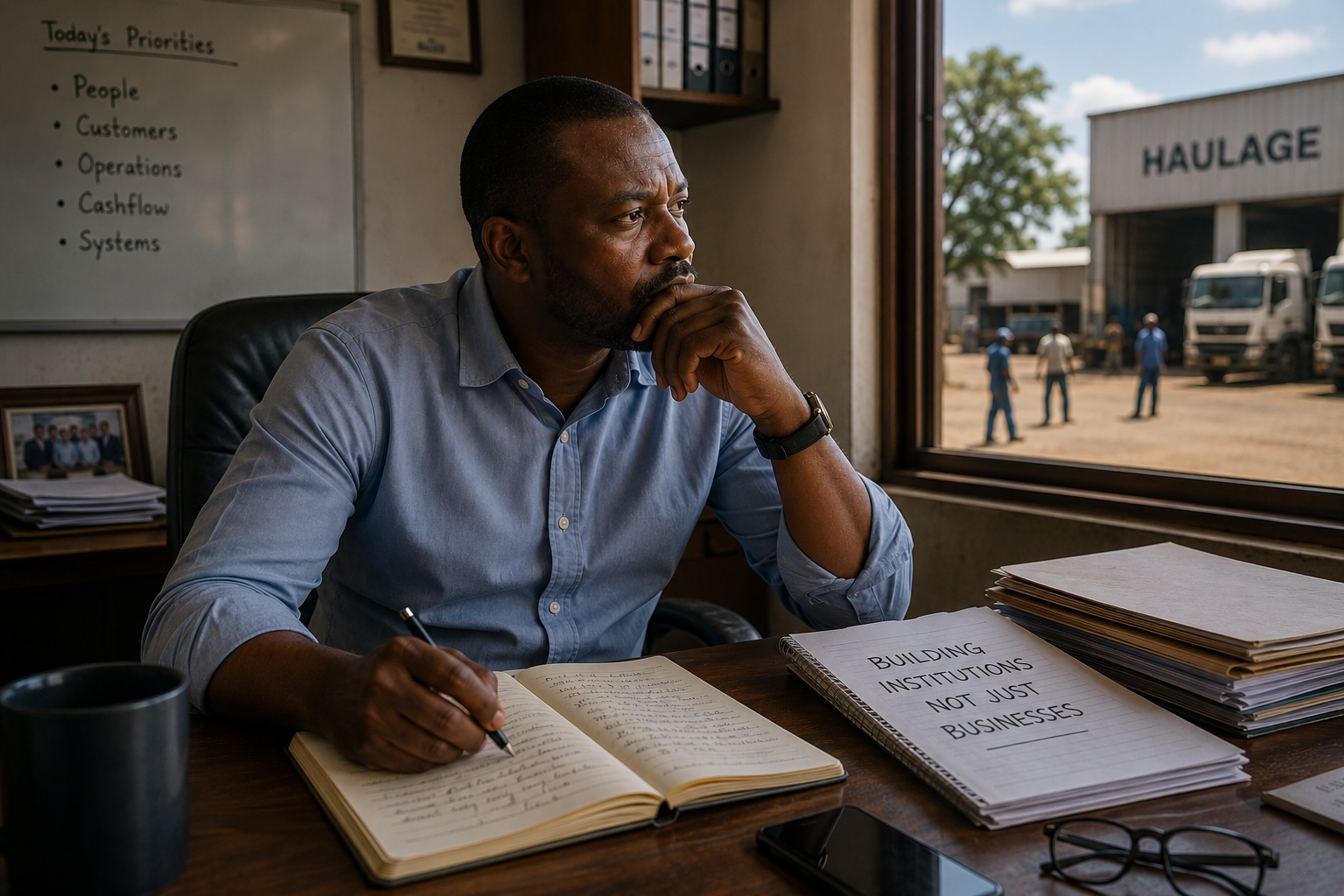
The Business That Knew Only One Voice
Notes from an African Entrepreneur
A few months ago, I spent time with the owner of a family business here in Zimbabwe.
It was one of those businesses you quietly admire. The yard was full of activity. Customers came and went, and employees were busy with their tasks. It was obvious that building this business had taken years of hard work. As we walked around, his phone never stopped ringing.
One call was from a supplier asking for approval. Another was from a driver with a problem on the road. Then came a customer wanting a discount. A manager needed authority to buy spare parts. The accountant wanted confirmation before making a payment.
Every conversation ended the same way.
“Let me ask the boss.”
Seeing this happen again and again made me start to wonder. What would happen if the boss turned off his phone for a week? Not because he wanted a break. Not because he had retired. Just because life happened. The uncomfortable truth was obvious.
The business was successful, but almost every important decision still relied on one person. And I realised something that has stayed with me ever since. Sometimes the greatest risk to a business isn’t competition.
It’s dependence. Zimbabwe has produced some remarkable entrepreneurs.
Many built businesses through hyperinflation, foreign currency shortages, fuel queues, policy changes, and economic uncertainty that would have broken companies elsewhere. When I think about what many founders have endured over the past two decades, I have enormous respect for them.
They built businesses by being present every day. They solved every problem themselves.
They knew every customer. They negotiated every deal.
That level of commitment is often what kept the business alive. But I’ve started to see that the habits that help us build a business don’t always help it grow on its own. This has been one of the most humbling lessons I’ve learned.
One lesson I am still learning is this:
There comes a point where working harder is no longer the answer. The answer is building better systems.
As entrepreneurs, we often convince ourselves that no one else can make decisions as well as we can.
Sometimes we’re right. But if that’s still the case five or ten years later, maybe we haven’t developed enough leaders around us. That thought challenges me as much as it does anyone else.
There are still decisions I instinctively want to make myself. There are conversations I feel I should personally handle. There are responsibilities I find difficult to let go of. Not because I distrust people.
Because I care deeply about the outcome. But slowly, I’m starting to see that stewardship isn’t about holding on to everything. Sometimes, stewardship means helping others take on responsibility and do it well. I’ve come to believe there’s a difference between owning a business and building an institution.
A business depends on its founder. An institution carries its values long after the founder has stepped away.
That distinction matters. Across Africa, we often celebrate entrepreneurs who never stop working.
Perhaps we should also celebrate those who build organisations that no longer need them every minute of every day. After all, our children cannot inherit knowledge that only exists in our heads.They inherit systems. They inherit culture. They inherit people who have been trusted and developed. This week, I have asked myself three simple questions. If I disappeared from my business for thirty days, what would stop?
Which decisions only I can currently make? And which of those decisions could I begin teaching someone else to make well? These are uncomfortable questions. I suspect they reveal more about a business’s health than a profit-and-loss statement ever could. Perhaps they’re worth asking yourself too.
When my father built our family business, he wasn’t simply trying to earn a living. He wanted to create something that would outlive him. I think about that often.
It reminds me that our responsibility as this generation of African entrepreneurs is not merely to build profIt’s about building businesses that last. These are the kinds of businesses that keep creating jobs, opportunities, and hope for years to come.ope for many years.
If these notes encourage even one founder to start making that change, then they’ve done their job.
Brian Munyawarara
Notes from an African Entrepreneur